
Field guide
How to Play
Each hero starts with 30 Health. Bring the enemy hero to zero by winning fights, finding open lanes and playing your cards in the right order.
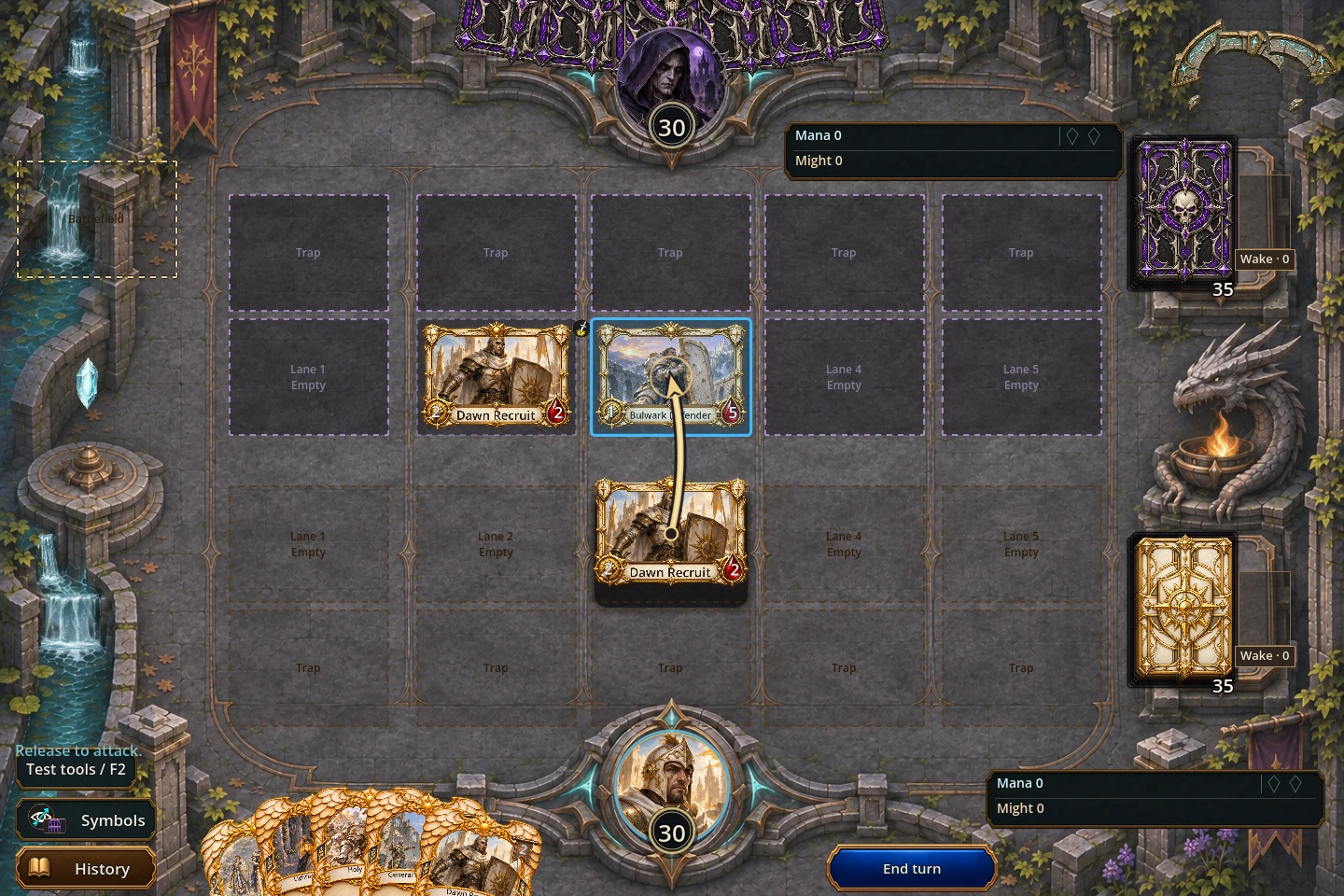
Choose your opening hand
Each player draws five cards. Select up to two to replace, then confirm your mulligan. You can also keep all five. A creature you can afford early gives you a way to contest a lane while you build up resources.
The second player receives Mana Essence after the mulligan. Play it for one flexible point towards your next paid card this turn. With 1 Might, for example, Essence lets you summon a 2-Might creature. An unused point expires at the end of the turn.
Follow a turn
Start-of-turn effects resolve, your resources refresh and you draw a card. During your turn you can play cards and declare attacks in the order you choose. Select End turn when you have finished.
Might pays for creatures. Mana pays for spells and Battlefields. Both start at one on your first turn and grow by one each turn, up to 10 Might and 6 base Mana. Spending Might leaves your Mana available for a spell that same turn.
Mana reserve. From the end of your sixth turn, you can carry up to two unspent base Mana into your next turn. Finish turn six with two base Mana left and you start turn seven with eight available. Reserve Mana is spent first. Unspent Might expires every turn.
Play onto the board
- Creatures
- Drag a creature from your hand to an available friendly lane. Each side has one creature slot per lane. The numbers at the bottom of the card show Attack on the left and Health on the right.
- Spells
- Drag a targeted spell onto a legal target. Some effects ask for more choices. Select the highlighted cards or lanes and confirm. Cancelling before confirmation keeps the card and its resources.
- Traps
- Set a trap face down in an empty friendly trap slot, even in a lane with a creature. Traps are free, and you may set one per turn. The player who goes first cannot set one on their first turn. An opponent sees the hidden card until its trigger reveals it.
- Battlefields
- A Battlefield occupies one shared slot. Playing a new one replaces the current one. For example, Holy Field gives creatures on both sides +2 Health and −1 Attack while active. Check the opposing board before you play it.
Declare an attack
Drag a ready creature onto the creature directly opposite it. If the opposing slot is empty, drag it onto the enemy hero instead. A creature can normally attack once on your turn and must wait through the turn it was summoned.
In ordinary creature combat, both creatures deal damage equal to their Attack at the same time. A creature at zero Health dies. If both take lethal damage, both die. Damage from an ordinary creature fight stays in that fight, even when the attacker deals more than the defender’s remaining Health.
Committing a lane. Declaring an attack closes your creature slot in that lane to ordinary summons for the rest of the turn. If your attacker dies in the fight, you still need another available lane to summon a replacement.
Hero abilities & Crownshards
Your hero’s ability
Your choice of hero determines your ability. Check its cost beside your hero portrait: some abilities use Mana, some spend charges, and some need both.
Zephyra can use Bottled Gale once per turn for 2 Mana. Choose a lane to reduce each hit of combat damage there by 2 until your next turn. The wind shelters both sides. Each hit it softens earns 2 Wind. At 8 Wind, your next activation unleashes a storm for 2 damage to every enemy creature instead.
Your faction’s Crownshard
Each faction has its own stone. Select the Crownshard beside your portrait during your turn, make any required choices, then confirm. You can invoke it only once per match.
The Primordials Crownshard suspends a lane on both sides. Its creatures and traps cannot act or be affected until they return at the start of your second turn after activation.
Raknor
From embers to Worldpyre
Ashreaper spends 4 Mana on Reap the Embers. The flames go out in lane one as the enemy hero takes 3 damage.
The Raknor Crownshard lets you sacrifice an ally you controlled at the start of the turn to summon a Dragon from your deck in its place. The Dragon can cost up to 3 Might more than the ally.
Here, an 8-Might Furnace Tyrant makes way for the 10-Might Rhazek. His summon scorches the chosen enemy lane and its neighbours, dealing 4 damage to each creature there.
Oathbreakers
Vardren’s Price of Corruption
Vardren starts this turn with two Corruption charges. He invokes the Oathbreakers Crownshard on a Sunshield Guard he already controlled at the start of the turn. The 1/4 Guard becomes a 4/1 Corrupted Sunshield Guard, giving Vardren his third charge.
With Price of Corruption, Vardren spends those three charges and discards Black Litany to deal 5 damage to the enemy Divine Commander.
Mechanics in action
Each position below assumes the printed card stats and no other effects. Select a card to read its full rules.


Who deals damage first?
Your ready Needleblade Scout faces a Dawn Recruit. Both are 2/2, enough to kill each other in ordinary combat. The Scout has First Strike. It deals 2 damage first, so the Recruit dies before it can deal damage back. The Scout finishes the fight at 2 Health.
If both creatures have First Strike, they deal their combat damage at the same time.
Can a new creature attack the hero?
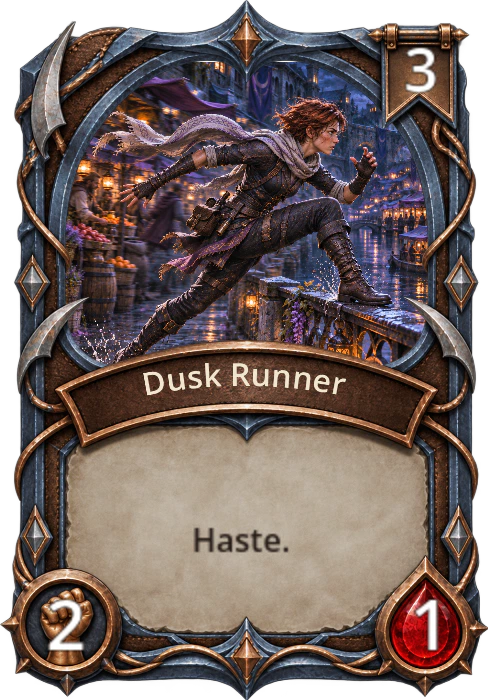
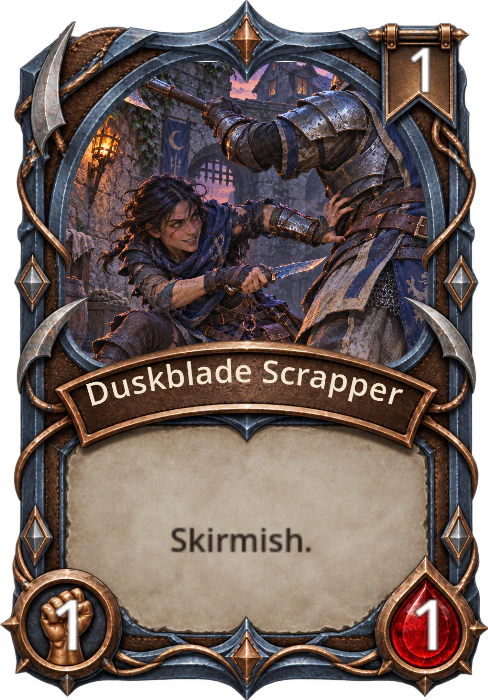
You want to deal damage this turn and the opposing slot is empty. Summon Dusk Runner there. Haste lets it attack immediately, so its 2 Attack can reach the hero. Duskblade Scrapper has Skirmish. On the turn you summon it, it can attack an opposing creature, but an empty lane gives it no legal attack.
Choose an open lane for the Runner when you want hero damage. Choose an occupied lane for the Scrapper when you want an immediate fight.
Why does the order of two cards matter?
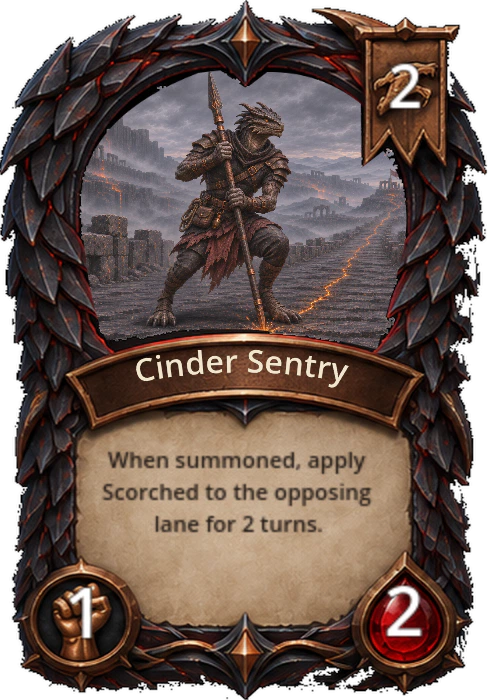
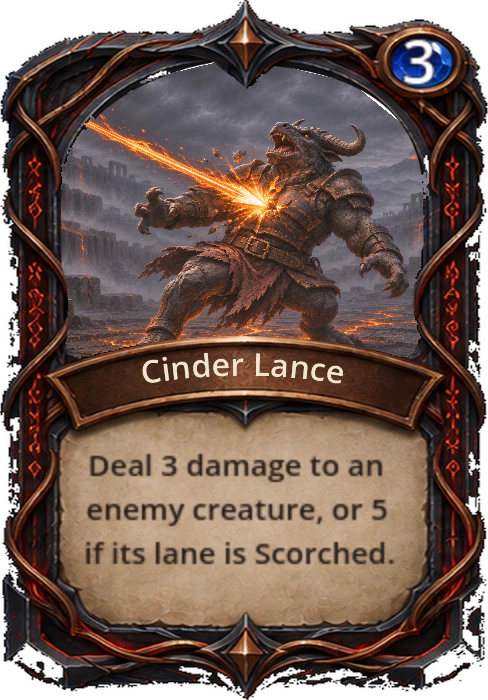
An enemy with 5 Health stands in an ordinary lane. With 2 Might and 3 Mana available, summon Cinder Sentry opposite it. The Sentry makes the enemy lane Scorched. Now cast Cinder Lance on the enemy. The spell deals 5 damage in a Scorched lane, enough to destroy it.
Cast the Lance first and it deals only 3. The Sentry changes the lane, so the order changes the outcome.
When does a marked creature die?
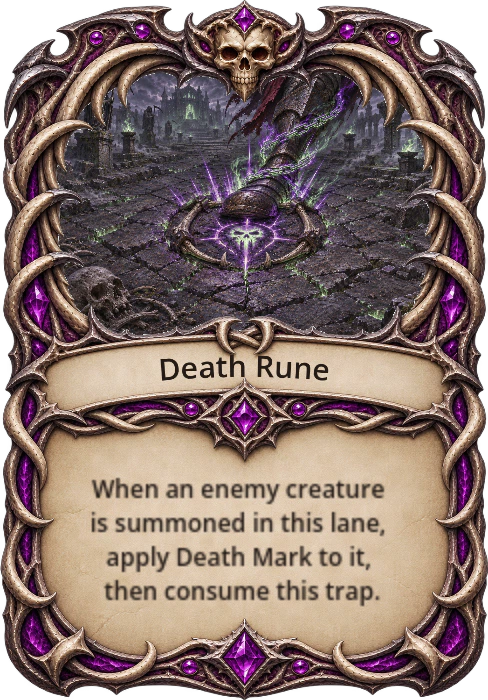
Set Death Rune in lane three. On the enemy turn, a creature is summoned opposite the trap. The Rune reveals itself, marks that creature and is consumed. The creature survives the summon. Its current turn was already under way, so the mark destroys it at the end of its controller’s following turn if it is still marked and in play.
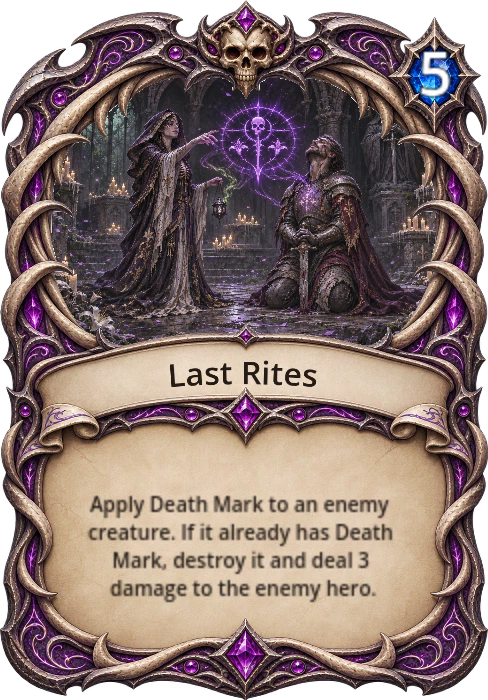
On your intervening turn, you can cast Last Rites on the marked creature to destroy it immediately and deal 3 damage to the enemy hero.
Legendary plays
Morgothar · 8 Might
Velyss, the Venom Matriarch
When summoned, Velyss can split up to three choices between enemy creatures and empty enemy lanes. Choose two creatures and one empty lane. Both creatures take 2 damage at once, and any survivor becomes Poisoned, losing 1 Health at the start of each of its turns.
The empty lane becomes Contaminated. The next creature to enter it by moving or being summoned becomes Poisoned and consumes the contamination. Even a lane with no target today can threaten the opponent’s next summon.
Neutral (Oryndai) · 7 Might
Ordan, the Celestial Adjudicator
Play Ordan to destroy every trap and the active Battlefield. A face-down trap is removed even if you never learned what was waiting there.
If your attacker faces a hidden trap, play Ordan before declaring the attack. Check your own side first. Your traps disappear too, and both players lose the Battlefield’s effect.
Oathbreakers · 9 Might
Corrupted Zerith, God of the Forsaken Flame
When summoned, Corrupted Zerith destroys every other creature. Zerith then deals 1 damage to the enemy hero for each enemy creature destroyed this way.
Suppose the enemy has three creatures and you have two. If all five are destroyed, the enemy hero loses 3 Health. Your two creatures are part of the price you pay for clearing the board.
Choose a faction
Each of the seven factions offers a different way to win the same five lanes. Collectible Neutral (Oryndai) cards can go in any faction’s deck.
Aurelith
Auroth leads the paladins of Aurelith into battle in the name of Zerith, god of the sacred flame.
Aurelith builds a formation across neighboring lanes. A creature can help win a fight it never enters, simply by standing beside the attacker. Health bonuses, healing and protection help that formation survive long enough to attack again.
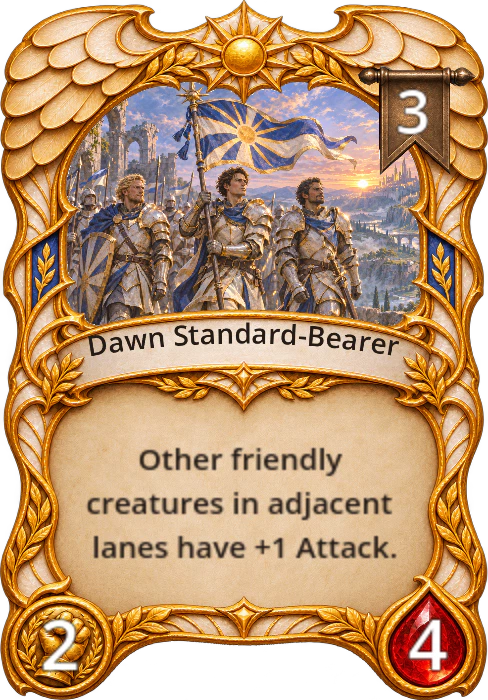
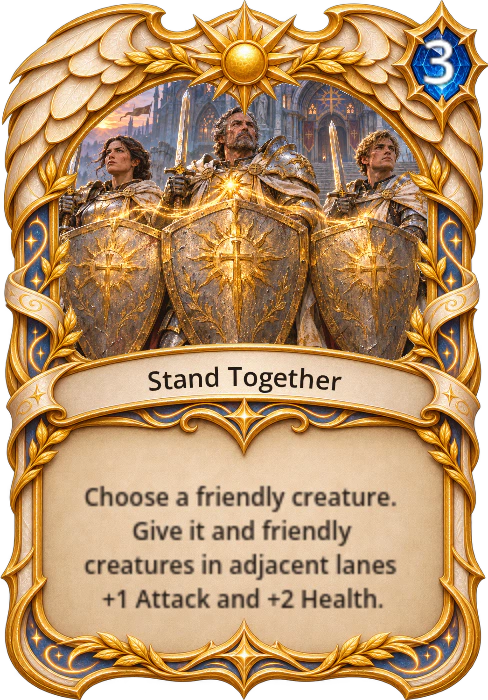
Place Dawn Standard-Bearer between two friendly creatures and both gain 1 Attack. Target the Standard-Bearer with Stand Together and all three gain another 1 Attack and 2 Health. In an outside lane, the same Standard-Bearer has room for only one neighbor.
Morgothar
Under Morveth, exiled necromancers commune with the dead and create monstrosities with minds of their own.
Morgothar can profit from losing its own creatures. Undead Minions fill open lanes, sacrifices pay for powerful effects, and some creatures leave a replacement or deal damage when they die. Poison and Death Mark give you ways to threaten an enemy that your creatures cannot beat in combat.
With an eligible Gravebound Devotee in play, cast Soul Exchange on a dangerous enemy. Sacrifice the Devotee to destroy that enemy and draw a card from the Devotee’s ability. Letting the same Devotee die in an ordinary fight would miss the draw because its ability specifically requires a sacrifice.


Ilyr
Seyra commands an order of assassins who strike from the shadows in service to their fractured god, Nhal’Riz’Zir.
Ilyr treats positioning as a weapon. Moving a defender can open a path to the hero, put an enemy across from the wrong attacker, or make that enemy vulnerable to a follow-up spell. An empty slot on the opponent’s side can be just as important as one on yours.
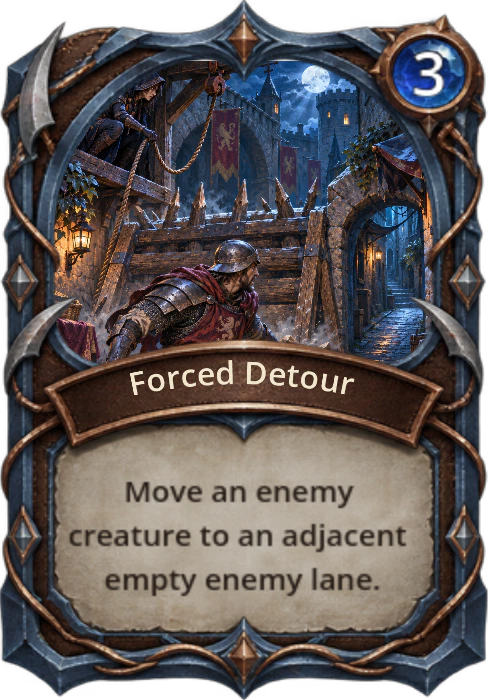
Forced Detour moves an enemy into an adjacent empty lane. You can attack through the opening you created, or use Execution by Design that turn to destroy the creature you moved. A newly summoned enemy has entered a lane, but only a move between lanes makes it eligible for the spell.

Raknor
Behind walls of volcanic stone, the dragon-blooded Raknorians train for war alongside ancient dragons.
Raknor sets lanes on fire, then decides how to spend that advantage. Scorched can strengthen a later spell or enable an immediate payoff. Dragons, Ember Whelps and Fireborn creatures give the faction ways to keep fighting while the opposing lanes are under pressure.
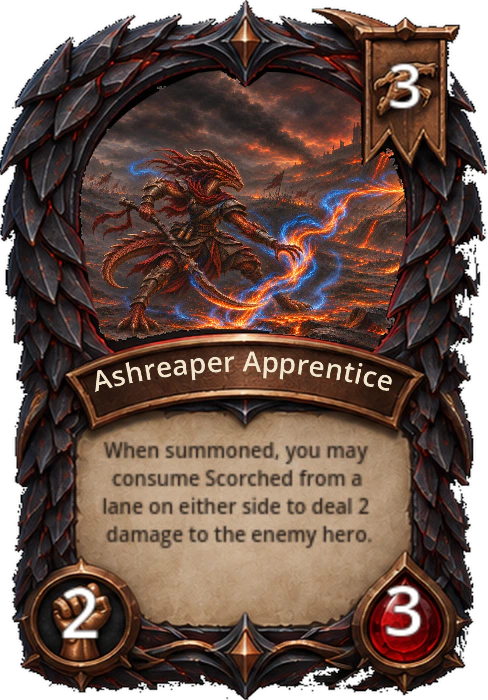
Summon Cinder Sentry to Scorch the lane opposite it. Leave the fire there and Cinder Lance can deal 5 damage to a creature in that lane. If the enemy hero has only 2 Health left, summon Ashreaper Apprentice instead and consume the fire to deal those final 2 damage directly.
Vezharyn
The bloodthirsty Vezhari and the ancient spirits of their forests owe fealty to Radovan.
Vezharyn spends its hero’s Health to gain creatures and turns Vampire Thralls into other resources. A Thrall can occupy a lane, attack, or become part of the cost of a spell. The right choice depends on how much damage the enemy can send back through the lanes you leave open.
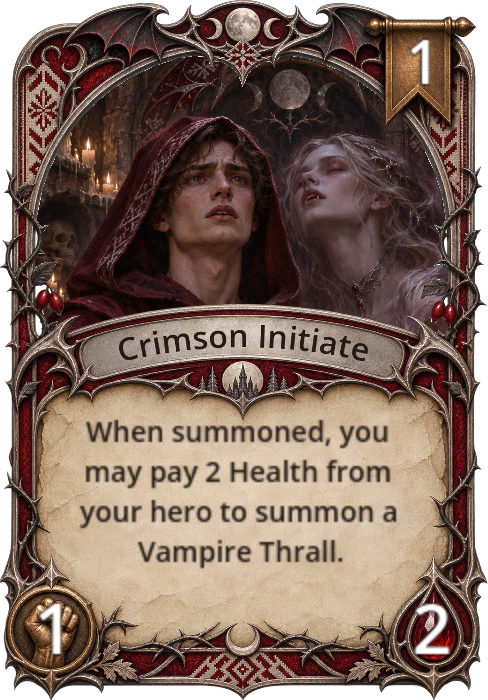
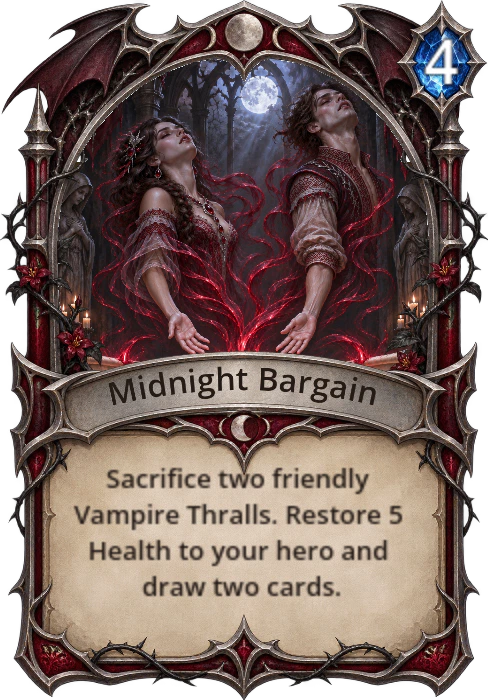
Crimson Initiate lets you pay 2 hero Health for a Vampire Thrall. If you already control another eligible Thrall, Midnight Bargain can sacrifice the pair to restore 5 hero Health and draw two cards. Check who was blocking the enemy before giving up both creatures.
Primordials
Guardians of the elements since the dawn of the world, the Primordials rise to stop the war for the Crownshards.
Primordials links fire, ice and movement. One play can change a lane, the next can exploit the creature standing there, and a third can move it out of the way. Some creatures also have Absorption, giving you the option to combine adjacent allies into a single larger threat.
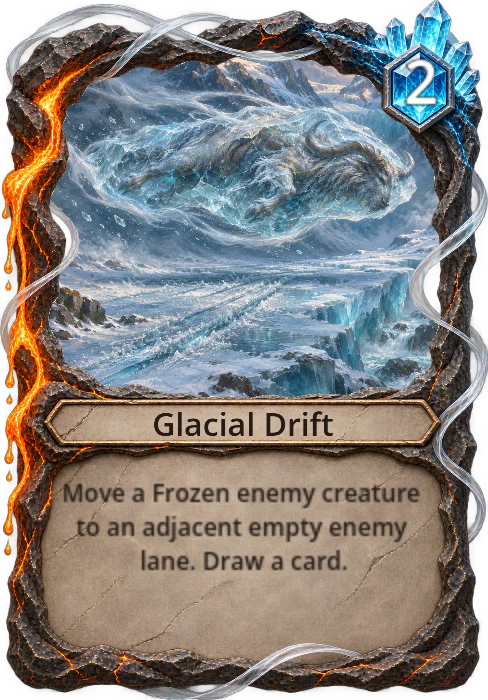
Summon Cinderwash Warden opposite an enemy in a Scorched lane. You may remove the fire to Freeze that creature until the end of its controller’s next turn. If the enemy has an empty slot beside it, Glacial Drift can then move the Frozen defender there and draw you a card.

Oathbreakers
Vardren left Aurelith with his followers after splitting the kingdom’s Crownshard. Wield his corrupted half to transform select Aurelith cards in your hand into their corrupted forms.
Oathbreakers can include up to 20 Aurelith cards with corrupted forms in their main deck. Those cards start in their original form. Corrupt changes an eligible card in your hand, so you can choose which version of its ability you want for the board in front of you. Other Oathbreakers cards let you spend a creature’s Resilient protection for an immediate effect.
With Divine Priest in hand, summon Forsworn Squire. Keep the Priest as it is if you want to split 4 damage between two enemies. Corrupt it if you want to hit one enemy for 4 and send excess damage to the enemy hero. Against a creature with 1 Health, the corrupted form can send the other 3 damage through.

